A damaged sewer line used to mean digging a trench across your entire yard. That is no longer the only option. Trenchless drain and sewer repair in Houston restores cracked, corroded, and root-damaged pipes through one or two small access points — no open trenching through your landscaping, driveway, or hardscaping. The Houston Plumbing Company performs trenchless pipe lining and pipe bursting for residential and commercial properties. We are licensed, insured, and backed by a 4.9-star Google rating with over 280 reviews.
Houston’s underground conditions demand repair methods built for this environment. Clay soil shifts and settles pipes over time. Slab foundations bury sewer lines under concrete where access is limited. Mature trees push roots into aging pipe joints year after year. Our team uses video camera inspection before and after every trenchless job to confirm the pipe’s condition and verify the completed repair. Not every pipe qualifies for trenchless — and we tell you that honestly. When the camera shows that lining or bursting will not hold, we recommend the method that will. Same-day diagnostics are available. Trenchless repair is one part of our drain and sewer services across Houston.
Call The Houston Plumbing Company today for a trenchless sewer inspection. We offer 24/7 emergency service for active backups and sewer line failures. Every job is camera-diagnosed and camera-verified — you see the problem and the repair on video.
What Trenchless Drain and Sewer Repair Actually Means
Traditional sewer repair starts with a backhoe. A trench is dug the full length of the damaged section, removing soil, landscaping, concrete, or whatever sits above the pipe. The repair gets done, but your property pays the price — torn-up yards, broken driveways, displaced plants, and weeks of restoration after the plumbing work is finished.
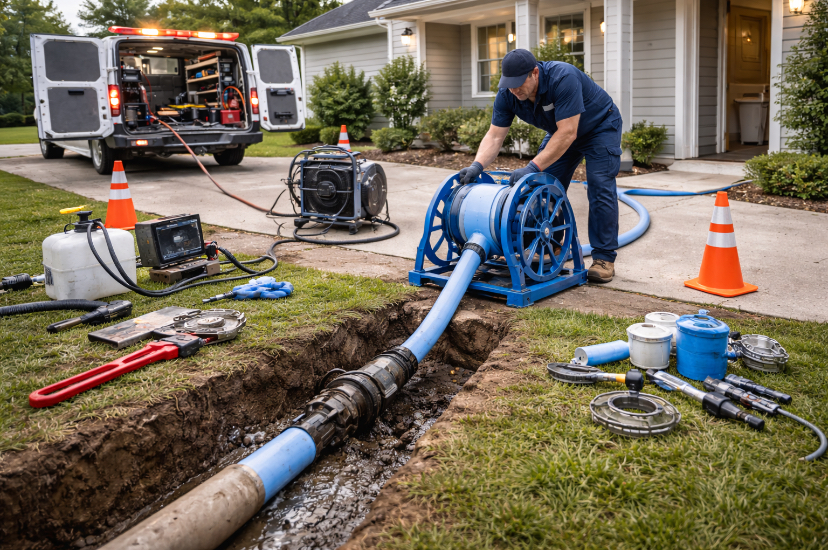
Trenchless repair takes a different path. Instead of digging down to the pipe from above, we access it through one or two small openings — typically at the cleanout and near the city connection. The repair happens inside the existing pipe path. Your yard, driveway, patio, and garden stay intact.
Two primary methods make this possible.
Pipe lining installs a new pipe inside the old one. A resin-coated liner is inserted into the damaged pipe, inflated against the walls, and cured in place. When it hardens, you have a smooth, jointless new pipe sitting inside the original shell. The old pipe becomes the outer casing, and the liner handles all the work.
Pipe bursting replaces the old pipe entirely. A new HDPE pipe is pulled through the damaged one using a bursting head that fractures the old pipe outward as it moves. The new pipe follows directly behind and takes the place of the old one in the same path. No trench required.
Both methods are performed from inside the pipe path. Both avoid the surface disruption that comes with traditional excavation. And both are verified with a video camera inspection after the work is complete.
Not every pipe qualifies for trenchless repair. Collapsed lines, severely back-graded pipes, and pipes that have lost their round shape may still require excavation to fix properly. A video camera inspection determines whether trenchless is an option for your specific pipe and damage type.
Homes in Memorial and River Oaks with large landscaped lots and established trees are strong candidates for trenchless methods. Houston properties with pools, extended driveways, and mature hardscaping above the sewer line benefit the most from keeping excavation to a minimum.
How Trenchless Pipe Lining Works in Houston Homes
Pipe lining — also called cured-in-place pipe or CIPP — creates a brand-new pipe inside your existing one. The old pipe stays in the ground. The liner becomes the functioning pipe. When properly installed, the result is a smooth, jointless interior that resists roots, corrosion, and buildup for decades.
The process begins with cleaning. Before any liner goes in, the pipe must be free of buildup, roots, and debris. We use hydro jetting or mechanical tools to strip the interior walls clean. Every inch of the pipe needs to be clear for the liner to bond properly. Skipping this step or doing it halfway compromises the entire repair.
Once the pipe is clean, a flexible liner saturated with epoxy resin is inserted through the cleanout or a small access point. The liner feeds through the full length of the damaged section. It is then inflated against the interior walls of the existing pipe using air or water pressure. The liner presses tight against the old pipe surface and holds its shape while the resin cures.
As the resin hardens, it bonds to the inside of the old pipe and forms a rigid, seamless new pipe within the original shell. There are no joints. Tree roots have no gaps to penetrate. The smooth interior surface resists grease adhesion and mineral scale buildup — two of the most common problems in Houston drain and sewer lines.
Houston’s hard water deposits and root intrusion at pipe joints make lining especially effective. The jointless design eliminates the two entry points that cause the most trouble in aging sewer systems. Cast iron and clay pipes common in older Houston homes are prime candidates for lining when they are still structurally round. Older systems in The Heights, Montrose, and Meyerland often qualify for lining instead of full replacement — saving the property from unnecessary excavation.
After the liner cures, we run a video camera through the full length of the repair. The post-lining inspection confirms the liner is properly seated, sealed at both ends, and flowing without restriction. You see the finished result on screen before we close out the job.
Most residential pipe lining jobs in Houston are completed in a single day. You wake up with a damaged sewer line and go to bed with a new one — without a single trench cut across your property.
How Trenchless Pipe Bursting Replaces a Full Sewer Line
Pipe lining repairs the existing pipe from within. Pipe bursting replaces it entirely. When a sewer line is too damaged for lining — cracked throughout, severely corroded, or compromised at multiple points — pipe bursting installs a brand-new pipe in the same path without digging a trench across your property.
The process starts with two small access pits. One is dug at each end of the damaged section — typically near the cleanout and near the city connection. These pits are the only excavation points. Everything between them stays untouched on the surface.
A bursting head is attached to a new HDPE pipe — high-density polyethylene — and pulled through the old sewer line from one pit to the other. As the bursting head travels through the old pipe, it fractures the damaged material outward into the surrounding soil. The new pipe follows directly behind, sliding into the exact position the old pipe held. One pass destroys the old line and installs the new one.
The old pipe is not removed. It is broken apart and displaced into the soil around the new line. The new HDPE pipe sits in its place, sealed and ready to carry wastewater from your home to the city main.
HDPE pipe is built for underground service. It is flexible enough to handle normal soil movement without cracking — a real advantage in Houston’s shifting clay. It is jointless, which means tree roots have no entry points. And it resists corrosion and chemical exposure far better than cast iron, clay, or Orangeburg — the materials it typically replaces in older Houston homes.
Pipe bursting works for full-length sewer line replacement when the pipe is too far gone for lining. If the line is cracked at multiple points, corroded throughout, or compromised from end to end, bursting gives you a completely new pipe without the disruption of an open trench.
Homes in Bellaire and West University Place with concrete driveways and tight lot lines often choose pipe bursting to minimize property disruption. Houston properties with pools, mature landscaping, or hardscaping above the sewer path benefit from keeping the surface intact while the pipe beneath it is fully replaced.
After the new pipe is in place, we run a video camera through the entire length. The post-repair inspection confirms the line is properly installed, sealed at both connections, and flowing without obstruction. You see the new pipe on screen before the access pits are backfilled and closed.
When Trenchless Repair Is the Right Fit and When It Is Not
Trenchless methods solve a wide range of sewer line problems. But they do not solve all of them. Knowing which situations qualify — and which ones do not — protects you from paying for a repair that will not hold up over time.
The camera inspection makes that determination. What we see inside the pipe dictates which method fits. Our recommendation is based on the condition of your specific line — not a default preference for one approach over another.
Good candidates for trenchless repair:
- Cracked or corroded pipes that are still round and structurally intact. The pipe has damage, but it has not lost its shape. Lining bonds to the interior and seals the cracks. Bursting replaces the pipe entirely.
- Root intrusion at joints with no collapse. Roots have entered through gaps between pipe sections, but the pipe itself has not caved in. Cleaning followed by lining eliminates the joints that roots use as entry points.
- Full-length deterioration where the pipe shape is maintained. The pipe is worn from end to end — corroded cast iron, aging clay, or degrading Orangeburg — but still holds its round profile. Lining or bursting can restore function without digging.
- Properties where surface disruption must be minimized. Landscaping, driveways, pools, patios, and hardscaping above the sewer line all benefit from trenchless access. The repair happens underground while the surface stays intact.
Situations that require excavation:
- Fully collapsed pipe sections. When the pipe has caved in and lost its shape, there is nothing for a liner to bond to and no path for a bursting head to follow. The collapsed section must be dug up and replaced.
- Severely back-graded lines that need slope correction. Lining and bursting follow the existing pipe path. If that path has lost its proper downhill grade, the new pipe will sit at the same incorrect slope. Excavation is needed to re-establish the correct angle for wastewater flow.
- Pipes with major bellies. A belly is a low spot where the pipe has sagged. Waste and water pool at the bottom instead of flowing through. Trenchless methods cannot lift a sagging pipe — excavation is required to support it at the proper grade.
- Orangeburg pipe that has deformed beyond repair from within. Orangeburg — a tar-paper pipe used in some mid-century Houston homes — softens and flattens over time. When it has lost its round shape, neither lining nor bursting can restore it. Excavation and full replacement are the only options.
We never recommend trenchless when the camera shows it will not hold. Recommending a liner for a collapsed pipe or bursting through a back-graded line wastes your money and leaves you with a repair that fails. The camera inspection is the deciding factor — and we share the footage with you so you can see exactly why we recommend one method over the other.
Houston’s shifting clay soil is responsible for many of the grade and belly issues we see in older sewer lines. The soil moves, the pipe follows, and over time the slope changes. When that happens, only excavation can correct the path. But when the pipe is damaged and the path is sound, trenchless repair saves your property from unnecessary digging.
We explain both options, the tradeoffs involved, and exactly why one fits your pipe better than the other. You make the final decision with full camera evidence in front of you.
How Long Trenchless Repairs Last and What Affects Their Lifespan
Trenchless repair is not a temporary patch. When properly installed, both pipe lining and pipe bursting are designed to last decades — on par with or longer than a brand-new traditionally installed sewer line.
CIPP pipe liners are rated for 50 or more years under normal conditions. The epoxy resin cures into a rigid, seamless tube that resists corrosion, root penetration, and chemical exposure. It does not rust like cast iron. It does not crack at joints like clay. And its smooth interior surface collects less buildup than the rough walls of the pipes it replaces.
HDPE pipe used in pipe bursting carries a similar design life — 50 or more years. HDPE is flexible, jointless, and engineered for underground service. It handles soil pressure, temperature changes, and normal ground movement without becoming brittle or cracking.
Installation quality is the single most important factor in how long either repair lasts. Proper cleaning before lining, correct resin saturation, accurate curing temperature and timing, and verified sealing at both ends all determine whether the liner performs as designed. For pipe bursting, correct alignment, proper fusion of pipe sections, and secure connections at entry and exit points set the foundation for long-term performance. A poorly installed trenchless repair — no matter how good the materials — will underperform.
Soil conditions play a role too. Houston’s clay soil exerts ongoing pressure on underground pipes as it expands and contracts with moisture. Both CIPP liners and HDPE pipe are designed to flex under that pressure without cracking — an advantage over rigid materials like cast iron and clay that fracture under the same stress. Homes in Katy, Cypress, and Sugar Land with newer developments on expansive clay benefit from the flexibility these materials provide.
Routine maintenance extends the life of any repair. A camera inspection every few years confirms the liner or new pipe is holding and the line stays clear. Avoiding chemical drain cleaners protects the liner surface from unnecessary chemical exposure that can degrade the resin over time.
Trenchless repair is a long-term restoration of the pipe’s function — not a stopgap. When the camera inspection confirms your pipe qualifies and the installation is done correctly, you are looking at a repair built to outlast most of the other systems in your home.
How We Diagnose Your Pipe Before Recommending Trenchless Repair
Every trenchless recommendation we make starts with a camera inside the pipe. Without seeing the interior condition, there is no way to know whether lining, bursting, or excavation is the right call. The diagnosis drives the method — not the other way around.
The inspection begins at the cleanout access point on your property. A small waterproof camera feeds into the sewer line and travels the full length of the pipe. The live video shows us everything happening inside — cracks, corrosion, root penetration, bellies, collapses, joint separation, and the overall condition of the pipe walls.
We record the full inspection. You watch the footage with us and see exactly what we see. There is no gap between what the camera finds and what we report. Every area of concern is pointed out as it appears on screen.
Locator equipment marks the exact position and depth of the damaged section from above ground. This tells us where the problem sits on your property — under the lawn, under the driveway, near the foundation, or close to the city connection. Knowing the location and depth affects which trenchless method is possible and how access will be handled.
Pipe material identification is part of every inspection. Houston homes have sewer lines made from cast iron, clay, Orangeburg, or PVC depending on when the home was built. Each material responds differently to lining and bursting. Cast iron with surface corrosion but a round profile is a strong candidate for lining. Orangeburg that has flattened is not. The material shapes the recommendation.
We assess whether the pipe is round enough for lining, intact enough for bursting, or too damaged for either. If trenchless will work, we tell you which method and why. If it will not, we explain what excavation involves and why it is the better path for your situation. You never get a recommendation without the camera evidence to support it.
Whether your home is in Copperfield, the Energy Corridor, or Bear Creek, inspection comes before any recommendation. Houston homes sit on slab foundations with sewer lines buried under concrete and soil. Nothing is visible from the surface. The camera is the only honest way to evaluate the pipe and match it to the right repair.
Every diagnosis ends with a full report — camera footage, pipe material, damage type, location, and our recommended repair method with the reasoning behind it. If your insurance policy includes sewer line coverage, the camera inspection report documents the damage and supports your claim with visual evidence. You make the final decision with all the information in front of you.
Frequently Asked Questions
Is trenchless sewer repair worth it for Houston homes?
Yes — trenchless repair restores damaged pipes with minimal property disruption and is designed to last 50 or more years. It is especially valuable for Houston properties with landscaping, driveways, pools, or hardscaping above the sewer line. A camera inspection determines whether your pipe qualifies for lining or bursting.
What are the disadvantages of trenchless pipe lining?
Lining cannot fix a collapsed pipe or correct a line that has lost its proper slope. The host pipe must be structurally round and intact enough to support the liner. Pipes with major bellies or severe deformation — like flattened Orangeburg — require excavation instead. A camera inspection confirms whether lining is an option for your damage.
How long does trenchless sewer repair last?
CIPP pipe liners and HDPE pipe used in pipe bursting are both rated for 50 or more years under normal conditions. Lifespan depends on proper installation, the condition of the pipe at the time of repair, and ongoing maintenance. Routine camera inspections every few years confirm the repair is holding.
Do plumbers recommend sewer liners?
Licensed plumbers recommend sewer liners when the camera inspection shows the pipe is structurally intact and round enough to accept a liner. Not every pipe qualifies. We recommend lining only when the pipe condition supports a long-term result — and suggest pipe bursting or excavation when it does not.
Will insurance pay for trenchless sewer repair?
Most standard homeowners insurance policies do not cover sewer line repair or replacement. Some carriers offer optional sewer line riders that add this coverage. A camera inspection report documents the damage with video evidence and can support a claim if you carry sewer line coverage. Check your policy before damage occurs.
Does The Houston Plumbing Company offer emergency trenchless sewer service?
Yes — we provide 24/7 emergency service for sewer backups and line failures across Houston. If your pipe qualifies for trenchless repair after camera inspection, we can move from diagnosis to repair without delay. Call us anytime for emergency sewer service.
Schedule Trenchless Drain and Sewer Repair in Houston Today
A damaged sewer line does not improve with time. Every day it sits, the crack spreads, the roots grow deeper, and the risk of a full backup increases. Trenchless repair fixes the pipe without destroying your property — and the sooner you act, the more repair options remain available.
The Houston Plumbing Company is licensed, insured, and rated 4.9 stars by Houston homeowners and businesses. Every job starts with a video camera inspection and ends with a camera-verified repair. Pipe lining and pipe bursting are available based on what your pipe needs — not a default method.
Same-day diagnostics and 24/7 emergency service are available. You get a free estimate and transparent pricing before any work begins. Collapsed lines may need full sewer repair and replacement instead of a liner.
Call (281) 247-5055 for trenchless drain and sewer repair in Houston.