
A failed plumbing pump does not give you much time to react. When a sump pump stops working during a storm, water fills the pit and starts flooding your home. When an ejector pump fails, sewage backs up through below-grade drains. When a booster pump drops out, water pressure disappears from every faucet in the building. Pump repair and replacement in Houston is not a project you can put off. The Houston Plumbing Company diagnoses and repairs all residential and commercial plumbing pumps — sump pumps, sewage ejector pumps, water booster pumps, and battery backup systems. We are licensed, insured, and backed by a 4.9-star Google rating with over 280 reviews.
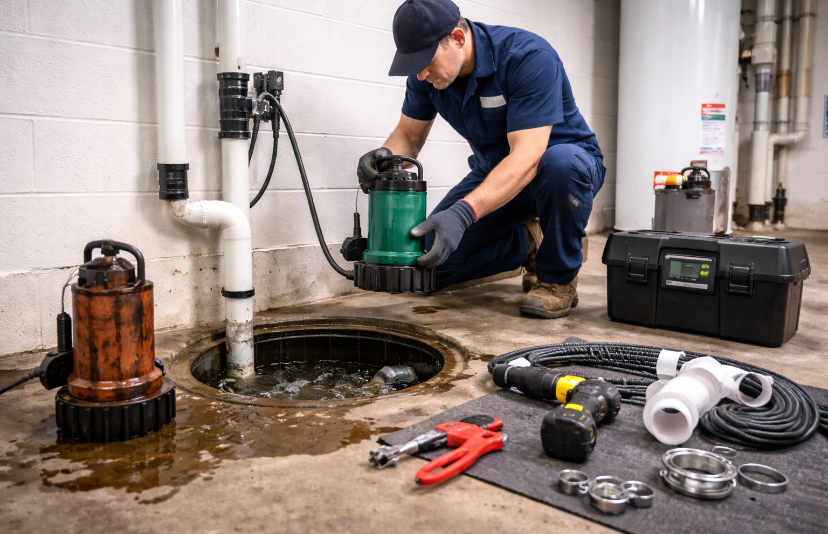
Houston homes depend on pumps more than most cities. Over 50 inches of rain falls here in an average year. Storm season brings intense downpours that overwhelm drainage systems in hours. High water tables push groundwater toward your foundation between storms. A working pump is active flood protection — not a background appliance. Our team diagnoses the problem first, then recommends repair or replacement based on the pump’s age, condition, and performance. We match the solution to what your system actually needs. Same-day service is available for urgent pump failures.
Call The Houston Plumbing Company today for pump diagnosis and service. We offer 24/7 emergency response for pump failures causing active flooding or sewage backup. Fast diagnosis — the right fix for your situation. Pump work is one part of our drain and sewer services across Greater Houston.
Signs Your Plumbing Pump Is Failing
Plumbing pumps often show warning signs before they quit completely. Catching those signs early gives you time to schedule a repair or replacement before a storm hits or sewage backs up. Ignoring them turns a fixable problem into an emergency.
Unusual sounds from the pump motor are one of the first warnings. Grinding means the bearings are wearing down. Rattling points to a loose or damaged impeller. A constant hum with no water movement suggests the motor is running but the pump is jammed or seized. Any new sound from the pit deserves attention.
A pump that runs without stopping is working against something it cannot overcome. The pit may be filling faster than the pump can empty it, the discharge line may be blocked, or the check valve may have failed — sending water back into the pit after every cycle. Continuous running burns out the motor faster and signals a system that is not keeping up.
Frequent cycling — the pump turning on and off in short bursts — usually points to a float switch problem or a unit that is undersized for the volume of water it handles. The pump activates, moves a small amount of water, shuts off, and restarts seconds later. This pattern wears the motor and switch prematurely.
Water pooling around the sump pit or ejector basin means the pump is not removing water fast enough or has stopped working altogether. If you see standing water where the pit should be dry, the pump needs immediate diagnosis.
Sewage odors near the ejector pump or wastewater backing up through below-grade drains signals an ejector pump failure. The pump is no longer moving waste up to the main sewer line, and the sewage has nowhere to go but back into your home.
Weak or inconsistent water pressure from a booster pump means the unit is losing its ability to maintain adequate supply pressure. The motor may be failing or the pump internals may be worn.
Visible rust, corrosion, or leaking from the pump housing tells you the unit is deteriorating. And any pump more than 7 to 10 years old with declining performance is approaching the end of its expected service life.
Low-lying areas near Copperfield and Bear Creek are especially dependent on working sump systems. Houston’s high water table and heavy rain put pumps under constant demand. If you notice any of these signs, schedule a diagnostic visit before the next storm puts your system to the test.
Types of Plumbing Pumps We Repair and Replace in Houston
Not all plumbing pumps do the same job. Each type handles a specific function in your home’s water or waste system. Knowing which pump you have helps you recognize problems faster and communicate clearly when you call for service.
Sump pumps are your primary defense against groundwater flooding. A sump pit sits beneath or beside the foundation, and the pump activates when water rises to a set level. The pump pushes water out through a discharge line and away from the home. In Houston, sump pumps run frequently during rain events and storm season. They handle the water that flat terrain and clay soil cannot drain on their own. Homes in Katy, Cypress, and Sugar Land with lower elevations often rely on sump pumps to manage groundwater during every significant rainfall.
Sewage ejector pumps handle wastewater from fixtures that sit below the main sewer line. If your home has a bathroom, laundry room, or utility sink below grade, an ejector pump moves that waste up to the sewer line so it can flow out to the city main. When the ejector pump fails, that waste has no path out — and it backs up into the fixtures it came from. This is both a health hazard and a property damage risk.
Water booster pumps increase water pressure inside homes or buildings that receive low pressure from the municipal supply. If your faucets, showers, and appliances are not getting enough pressure to operate properly, a booster pump brings the supply up to a functional level. When the booster pump fails, pressure drops throughout the building.
Battery backup sump pumps are a secondary system that activates when the power goes out. Houston storms frequently knock out electricity — and that is exactly when your sump pump is working hardest. A battery backup keeps the sump system running during outages so water does not rise unchecked while you wait for power to return.
We diagnose, repair, and replace all four types for residential and commercial properties. Each pump type has different components, failure points, and sizing requirements. Proper identification during the diagnostic visit determines the right repair approach and the correct replacement unit if one is needed.
When to Repair Your Pump and When to Replace It
This is the most common question homeowners ask when a pump starts failing. The honest answer depends on the pump’s age, the type of failure, and whether the unit is properly sized for your home. We diagnose before we recommend — you see the condition of the pump and the specific failure point before making a decision.
Repair makes sense when:
- The pump is under 7 years old and the motor is still strong
- The failure is a single component — a float switch, check valve, impeller, or capacitor
- The pump is properly sized for your home’s water volume and pit dimensions
- The unit has no history of repeated failures
A single-component repair on a pump that is otherwise in good condition gives you years of additional service. Replacing a float switch or check valve is straightforward and restores function without the cost of a full new unit.
Replacement is the better call when:
- The pump is over 7 to 10 years old and performance has been declining
- The repair cost approaches half the cost of a new unit
- The pump has failed multiple times in the past two years
- The unit is undersized for the demand placed on it
A pump that runs constantly during normal Houston rain is almost always undersized. The motor works harder than it should, the switch cycles too often, and every component wears faster. Replacing it with a properly sized unit solves the problem at the source instead of patching a system that will keep struggling.
Houston’s demanding conditions play a direct role in pump lifespan. Frequent heavy rain, high humidity, and power outages push pumps harder and more often than homes in drier climates. A pump rated for 10 years in a moderate environment may reach the end of its useful life closer to 7 in Houston. If your pump is in that range and showing signs of decline, replacement prevents the emergency failure that usually follows.
Every replacement we install is sized to match your property’s water volume and pit dimensions. An oversized pump cycles too frequently. An undersized pump cannot keep up. Proper sizing is the foundation of a pump system that performs when Houston weather demands it.
We explain the diagnosis, show you the failed component, and walk through both options. You make the call with the full picture in front of you.
How Pump Repair and Replacement Works
Knowing what happens during the service visit helps you plan your day and feel confident about the process. Most pump repairs and replacements are completed in a single visit. Here is what to expect from start to finish.
Step 1 — We inspect the pump and its components.
Our plumber checks the motor, float switch, discharge line, check valve, and electrical connections. We look at the pit or basin condition and check for debris that may be interfering with operation. The goal is to identify the specific point of failure — not just confirm the pump is not working.
Step 2 — We test the pump under load.
We add water to the pit and watch the pump respond. This tells us whether the motor activates, the switch triggers at the correct level, the impeller moves water effectively, and the check valve holds after the cycle completes. Testing under real conditions reveals problems that a visual inspection alone cannot catch.
Step 3 — We explain what we found.
You hear the specific component that failed and why it failed. If the pump is repairable, we tell you what the repair involves and what to expect from the unit going forward. If replacement is the better path, we explain why and walk through the sizing and installation plan.
Step 4 — For repairs.
We replace the failed part on site. A new float switch, check valve, impeller, or capacitor is installed and the pump is tested through a full cycle. We confirm the pump activates at the correct water level, moves water through the discharge line, and shuts off properly when the pit is clear.
Step 5 — For replacements
We remove the old pump from the pit or basin. A new, properly sized unit is installed in its place. The discharge line is connected, the electrical is wired, and the check valve is verified. We set the float switch to the correct activation level for your pit dimensions and water volume.
Step 6 — We verify full operation.
Whether the job was a repair or a replacement, we run the pump through multiple cycles before leaving. The pump must activate, move water, and shut off correctly every time. You see the system working before we close out the job.
Whether your home is in the Energy Corridor, Memorial, or Spring Branch, the process stays the same. Houston homes on slab foundations have pump pits and ejector basins in specific locations dictated by the foundation design. We work within your home’s layout and leave the area clean when the job is done. Most repairs and replacements are finished the same day you call.
Why Houston Homes Depend on Reliable Pump Systems
In most cities, a plumbing pump is a secondary system that runs occasionally. In Houston, it is front-line protection for your home. The combination of rainfall volume, flat terrain, clay soil, and a high water table creates conditions where pumps work harder and more often than almost anywhere else in the country.
Houston averages over 50 inches of rain per year — one of the highest totals among major U.S. cities. That rain does not drain quickly. The land is flat. The clay soil absorbs water slowly and expands as it saturates, pushing groundwater toward foundations instead of drawing it away. Sump pumps carry the load that the ground cannot handle on its own.
Storm season runs from June through November. During that stretch, Houston regularly sees intense downpours that dump several inches of rain in a matter of hours. Drainage systems overflow. Streets flood. And the water table rises rapidly around your foundation. A sump pump that is working properly moves that water out before it reaches your home. A pump that has failed — or was already struggling — lets it in.
Power outages make the situation worse. Houston storms frequently knock out electricity across entire neighborhoods. Your electric sump pump stops the moment the power goes out — at the exact time water volume is at its peak. A battery backup sump pump is the only protection during an outage. Without one, your pit fills and the water has nowhere to go.
Sewage ejector pumps face the same urgency. When an ejector fails, every flush and every drain from a below-grade fixture sends waste into a basin that can no longer empty itself. The backup is a health hazard and a property damage event that escalates quickly.
Flood-prone areas near The Heights, Meyerland, and Bellaire have seen the consequences of pump failure during major rain events. Homes without functioning pump systems during those storms absorbed the full volume of groundwater and surface runoff with no mechanical way to move it out.
Fast pump repair and proper sizing reduce flood risk when Houston weather tests your system. A pump that is correctly sized, recently inspected, and in good working order gives your home the best chance of staying dry when the next storm arrives.
What Affects the Life of Your Plumbing Pump
Every plumbing pump has a limited service life. Most sump and ejector pumps last 7 to 10 years under Houston conditions. Some last longer. Some fail sooner. The difference comes down to how hard the pump works, how well it is maintained, and whether the right unit was installed in the first place.
Run frequency is the biggest factor. A pump that cycles dozens of times during every Houston rain event wears faster than one that runs occasionally. The motor, switch, and impeller all have a finite number of cycles before they degrade. Proper sizing reduces unnecessary cycling — a pump matched to your pit volume and water demand runs less often per event and lasts longer as a result.
Power surges from electrical storms damage pump motors and control boards. A single surge can burn out a motor instantly or weaken it enough that it fails weeks later during the next heavy demand. Installing a surge protector on the pump circuit adds a layer of protection that costs very little compared to replacing the pump.
Debris in the pit is a common and preventable cause of failure. Dirt, gravel, small tools, and other objects fall into sump pits over time. That debris clogs the impeller, jams the float switch, or blocks the intake screen. A clear pit lets the pump operate the way it was designed to.
Check valve condition directly affects pump workload. The check valve sits on the discharge line and prevents water from flowing back into the pit after the pump shuts off. When the valve fails, water drains back down and the pump has to re-pump the same water on the next cycle. That doubled workload cuts pump life dramatically.
Houston’s high humidity and warm temperatures promote corrosion on pump housings, electrical connections, and internal components. Pumps in humid environments age faster on the outside even when they are functioning normally on the inside.
Hard water mineral deposits can build up on impellers and reduce pump efficiency over time. The pump works harder to move the same volume of water, and the motor draws more energy per cycle.
Lack of testing catches many homeowners off guard. Pumps can sit idle for months between rain events. When the first heavy storm arrives, the pump fails because a switch stuck, a bearing seized, or the motor lost power during the dry stretch. Pouring water into the pit every few months confirms the pump activates and completes a full cycle. It takes two minutes and prevents the worst-case scenario.
Properties in River Oaks and West University Place with older plumbing infrastructure should inspect pumps annually. A licensed plumber checks every component — motor, switch, impeller, check valve, discharge line, and pit condition — and catches worn parts before they fail completely. Annual inspection is the simplest way to extend pump life and avoid emergency calls during the storms that test your system the hardest.
Frequently Asked Questions
What are the signs my plumbing pump is failing?
Unusual noises, frequent cycling, continuous running, water pooling around the pit, sewage odors, weak water pressure, and visible corrosion are the most common signs. A pump that is more than 7 to 10 years old with declining performance is approaching the end of its service life. A diagnostic visit confirms the specific failure.
Is it better to repair or replace my pump?
Repair makes sense when the pump is under 7 years old and the failure is a single component like a float switch or check valve. Replace when the pump is aging, undersized, or has failed multiple times. We diagnose the specific problem first so you see the condition of the pump before deciding.
Is replacing a plumbing pump a big job?
Most residential pump replacements are completed in a single day. The process includes removing the old unit, installing a properly sized replacement, connecting the discharge line, and verifying operation through multiple full cycles. The work is contained to the area around the pit or basin.
Can a plumber repair or replace a sump pump?
Yes — licensed plumbers diagnose, repair, and replace sump pumps, sewage ejector pumps, booster pumps, and battery backup sump systems. Plumbing pumps connect to your drain, sewer, or water supply lines and require licensed work for proper installation and code compliance.
Does homeowners insurance cover pump replacement?
Most standard policies do not cover pump repair or replacement as a maintenance item. Some policies cover water damage caused by a pump failure but not the pump itself. Check your policy for specific coverage details before a failure occurs — routine maintenance helps reduce the risk of a claim situation.
Does The Houston Plumbing Company offer emergency pump repair?
Yes — we provide 24/7 emergency service for pump failures causing active flooding or sewage backup across Houston. Call us anytime, day or night. If your pump has failed and water is rising or sewage is backing up, our team will respond as quickly as possible.
Schedule Pump Repair or Replacement in Houston Today
A failing pump puts your home at risk for flooding and sewage backup. Do not wait for a complete failure during the next Houston storm to find out your system needed attention. Early diagnosis gives you time to repair or replace on your schedule — not in the middle of an emergency.
The Houston Plumbing Company is licensed, insured, and rated 4.9 stars by Houston homeowners and businesses. We diagnose the problem, explain your options, and complete the repair or replacement — most jobs finished the same day. Sump pumps, ejector pumps, booster pumps, and battery backup systems.
Same-day service and 24/7 emergency response are available. You get a free estimate and transparent pricing before any work begins. A failed ejector pump often leads to sewer backup repair in the lower level.
Call (281) 247-5055 for pump repair and replacement in Houston.