
Standing water in your yard is not just an eyesore — it is a direct threat to your foundation. Exterior drain services in Houston protect your home, your landscape, and your property value by moving water away from where it causes damage. The Houston Plumbing Company installs, repairs, and maintains exterior drain systems for residential and commercial properties across the Greater Houston area. Our licensed and insured plumbers have earned a 4.9-star Google rating with over 280 reviews. We solve yard drainage problems at the source — not with temporary fixes.
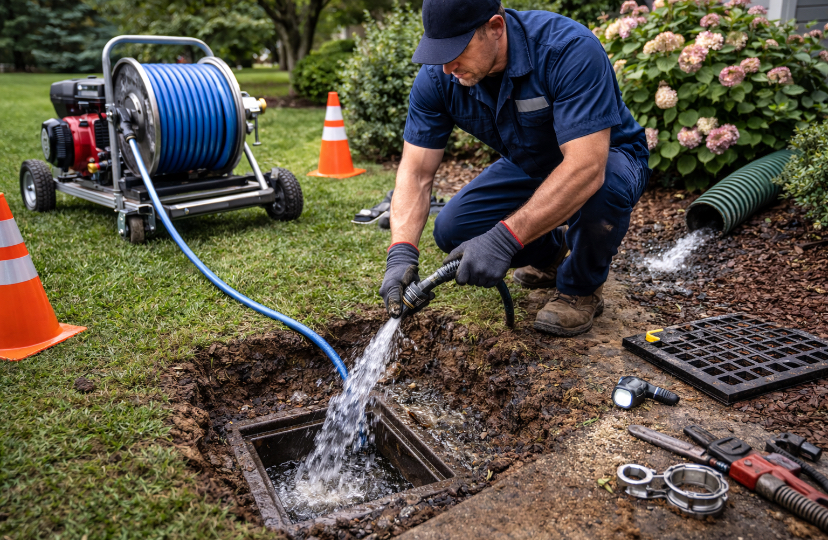
We install French drains, surface drains, channel drains, catch basins, and downspout extensions. We also repair and reroute existing exterior drain systems that are clogged, collapsed, or undersized for the water volume they handle. Houston’s flat terrain, clay soil, and heavy annual rainfall make professional drainage installation a necessity — not a luxury.
Stop standing water from threatening your foundation and destroying your yard. Call The Houston Plumbing Company today to schedule a yard drainage evaluation. Same-day appointments are available across Houston. Yard drains are one part of our drain and sewer services across Greater Houston.
Signs of Poor Yard Drainage Around Your Houston Home
Yard drainage problems do not always start with a flood. Most begin with small, easy-to-miss signs that get worse over time. Knowing what to look for helps you act before water reaches your foundation.
Standing water after rain. If water is still sitting in your yard 24 to 48 hours after rain stops, the soil is not draining. On a properly graded property, surface water should move away from the home within hours. In Houston, the heavy clay soil becomes saturated quickly and stops accepting water — leaving it with nowhere to go.
Soggy or spongy patches. Areas of grass that feel soft and wet underfoot even during warm, dry weather point to subsurface water that is trapped. These spots stay wet because the clay beneath them holds moisture instead of releasing it.
Erosion channels. If you see soil washing away along the foundation, fence line, or between your property and a neighbor’s, water is flowing with enough force to carve a path. This gets worse with each storm.
Water pooling against the foundation. This is the most urgent sign. Water sitting against the slab saturates the soil underneath and causes the clay to expand unevenly. Over time, this leads to foundation movement. Low-lying Houston neighborhoods like Meyerland, Copperfield, and Bear Creek see this problem frequently — especially after heavy rain events from May through October.
Mold on exterior walls. Mold or mildew growing on the outside of your home near ground level means moisture is sitting against the structure long enough to promote growth.
Downspouts with no redirect. If your gutter downspouts dump water directly at the foundation with no underground pipe carrying it away, every rainstorm sends hundreds of gallons right where you do not want it.
If you notice any of these signs at your Houston home, the yard needs a professional drainage evaluation — not a bag of topsoil or a splash block.
Types of Exterior Drains Used in Houston Properties
Not every drainage problem calls for the same solution. The right exterior drain depends on where the water is coming from, where it needs to go, and how your Houston property is laid out. Here are the five main types of exterior drains we install.
French drain. A trench is dug, lined with filter fabric, filled with gravel, and fitted with a perforated pipe. The pipe collects subsurface water that saturates the soil and channels it to a discharge point away from your home. French drains are one of the most effective solutions for Houston’s clay soil because they intercept water below the surface before it reaches the foundation.
Surface drain. A grate-covered inlet is set at ground level in a low spot where water collects. The grate catches standing water and sends it through a solid pipe to a discharge point. Surface drains work well in flat Houston yards where water has no natural path to follow.
Channel drain. A long, narrow grate is installed across a driveway, patio, or walkway. It intercepts sheet flow — water running across a hard surface — before it reaches the garage, foundation, or landscaping. Channel drains are common on Houston properties where concrete slopes toward the home instead of away from it.
Catch basin. A collection box receives water from multiple drain lines and routes it to a single discharge point. Catch basins act as a junction in larger drainage systems. They are useful on bigger Houston properties — especially in Memorial and River Oaks where large lots require multiple drain lines working together.
Downspout drain. A solid underground pipe connects to the gutter downspout and carries roof water away from the foundation. Instead of dumping hundreds of gallons at the base of your home with every storm, the water is redirected to a safe discharge location across the yard.
Most Houston properties benefit from a combination of these drain types. Your plumber evaluates the property, identifies the water sources, and recommends the right system based on where the water is coming from and where it needs to go.
Why Houston’s Soil and Climate Create Yard Drainage Problems
If your yard holds water after every rain, you are not alone. Houston’s geography works against natural drainage in ways that most other cities do not experience. Three factors combine to make exterior drainage a persistent issue across nearly every Houston neighborhood.
The soil does not drain. Houston sits on heavy clay formations — the Beaumont and Lissie clays that run beneath most of the metro area. Clay absorbs water very slowly. During a heavy rain, the soil saturates within minutes and stops accepting water entirely. Once that happens, every additional drop stays on the surface.
The land is flat. Most Houston neighborhoods have almost no natural slope. Water needs gravity to move, and without a grade change, it has no direction to flow. It sits where it falls — in your yard, against your foundation, and between properties. There is no natural path carrying it away.
The rain is heavy and frequent. Houston receives over 50 inches of rain annually. The heaviest volume falls between May and October during storm season, when single events can drop several inches in a matter of hours. That volume overwhelms flat, clay-covered lots that have no engineered drainage in place.
New construction and filled lots add to the problem. The building process compacts the soil, reducing its already limited ability to absorb water. Neighboring properties at slightly higher elevation can redirect their runoff onto your lot — and without a drain system, you have no way to manage it.
These conditions are not limited to one part of Houston. They affect homes across the metro — from Langham Creek to Bellaire and everywhere in between. Without an engineered exterior drain system, water pools against foundations, destroys landscaping, and creates breeding grounds for mosquitoes.
How Professional Exterior Drain Installation Works in Houston
A professional drainage installation follows a clear process from start to finish. Every step is designed to move water away from your home and yard using gravity, proper materials, and a system built for Houston’s soil conditions.
Your plumber starts by walking the property. The goal is to identify where the water is coming from, which direction it flows, and where the low spots are. Downspout locations, neighboring property grades, and existing hardscape are all factored into the evaluation.
A drainage plan is designed based on your property’s layout and the type of water problem. Some homes need a single French drain along the foundation. Others need a combination of surface drains, catch basins, and downspout redirects working together across the full lot.
Trenches are dug to the proper depth and graded so water flows by gravity toward the discharge point. In Houston’s clay soil, this step is critical — without the right grade, water sits in the pipe instead of moving through it.
A gravel bed is placed at the bottom of each trench. Filter fabric wraps the gravel and pipe to prevent Houston’s clay from migrating into the system and clogging it over time. This barrier is what separates a drain that lasts from one that fails within a few years.
Drain pipe, grate inlets, catch basins, and all connections are installed according to the plan. Projects in The Heights and West University often require working around mature trees, established landscaping, and narrow lot lines — your plumber accounts for all of these during layout.
The system is tested with water to confirm proper flow and discharge at every point. Trenches are then backfilled, compacted, and restored. Sod or landscape material is replaced as needed.
Your plumber reviews the completed system with you and explains how to maintain it going forward.
Who to Call for Yard Drainage Problems in Houston
When water is pooling in your yard or sitting against your foundation, the first question is who to call. A plumber, a landscaper, and a general contractor all work on outdoor projects — but they handle different parts of the job.
A licensed plumber is the right call for underground exterior drain installation, repair, and rerouting. Plumbers design gravity-fed pipe systems, set the proper grade, install catch basins and grate inlets, and connect everything to the appropriate discharge point. For drainage that runs near the foundation or connects to the public storm sewer, a licensed plumber is required in Houston. The City of Houston may also require permits for this type of work — and a licensed plumber handles that process.
A landscaper handles surface-level work. Regrading soil, installing sod, shaping plant beds for better surface drainage, and managing the cosmetic restoration after a drain project are all landscaper tasks. However, landscapers typically do not install underground pipe systems. If someone suggests fixing a serious drainage problem with just regrading and topsoil, the water will likely return after the next heavy storm.
A general contractor may coordinate drainage as part of a larger construction or renovation project. In most cases, the underground plumbing portion is subcontracted to a licensed plumber.
For Houston properties in Cinco Ranch and Spring Branch that need both underground drainage and surface grading, the most effective approach is a licensed plumber for the infrastructure and a landscaper for the finish work. The Houston Plumbing Company handles the full exterior drain project — from initial evaluation to underground installation to final testing. If your project also needs surface grading or landscape restoration, we coordinate with your landscaper to complete the work.
How to Maintain Your Exterior Drain System in Houston
An exterior drain system is built to work for years — but only if it is maintained. Houston’s climate and soil put constant demands on outdoor drainage. A few simple steps keep your system running at full capacity and help you avoid costly repairs.
Clear grate inlets after every major storm. Leaves, mulch, silt, and landscape debris collect on top of grate covers and block water from entering the system. If the grate is covered, the drain cannot do its job. A quick check after each storm takes less than a minute and prevents the most common cause of system failure.
Flush French drain lines once or twice a year. Run a garden hose into the cleanout or entry point of the French drain and let water push through the full length of the pipe. This clears sediment that settles inside the line over time. Houston’s clay soil produces fine particles that work their way into even well-protected systems.
Check downspout connections. Walk the perimeter of your home and confirm that each gutter downspout is still securely connected to the underground drain pipe. Connections can shift or separate during heavy rain, soil settlement, or lawn maintenance. A disconnected downspout dumps roof water right at the foundation — exactly where it causes the most damage.
Inspect catch basins annually. Open the lid and remove any accumulated silt, leaves, or debris from inside the box. A catch basin full of sediment restricts flow through the entire system. Homes in River Oaks and Montrose with mature tree canopies generate more organic debris that reaches exterior drains — annual cleanouts keep the system clear.
Watch for new standing water. Soil settlement over time can redirect water flow and create new low spots that the original system may not reach. If water begins pooling in an area that was previously dry, the grade may have shifted.
If drainage slows or standing water returns to a previously dry area, schedule a professional inspection. Your plumber can check for pipe clogs, soil intrusion, or system damage and recommend the right fix.
Frequently Asked Questions
What are the signs of poor yard drainage in Houston?
Standing water that remains 24 to 48 hours after rain, soggy patches that never dry, erosion along the foundation, water pooling against the slab, and mold on exterior walls are all signs of poor drainage. Houston’s clay soil and flat terrain make these problems common across most neighborhoods.
What type of exterior drain do I need for my Houston property?
It depends on the water source and your property layout. French drains handle subsurface water and foundation protection. Surface drains collect standing water in low spots. Channel drains intercept flow across driveways and patios. Downspout drains redirect roof water underground. A licensed plumber evaluates your property and recommends the right system.
Should I call a plumber or a landscaper for yard drainage in Houston?
Call a licensed plumber for underground drain installation, repair, and rerouting. Landscapers handle surface grading and sod work but typically do not install underground pipe systems. For drainage near the foundation or connecting to the storm sewer, a licensed plumber is required in Houston.
Why does my Houston yard hold water after rain?
Houston’s heavy clay soil absorbs water very slowly, the terrain is flat with minimal natural slope, and annual rainfall exceeds 50 inches. These three conditions prevent water from draining on its own. A professional exterior drain system redirects water away from your home and yard through underground pipe.
How do I maintain my exterior drain system in Houston?
Clear debris from grate inlets after storms, flush French drain lines with a hose once or twice a year, inspect catch basins for sediment annually, and check downspout connections regularly. If drainage slows or new standing water appears, schedule a professional inspection.
Does exterior drain installation require a permit in Houston?
The City of Houston may require a permit for drainage work that connects to the public storm sewer. Licensed plumbers handle the permit process when required. Call The Houston Plumbing Company for a property evaluation and we will advise on permit needs for your specific project.
Schedule Your Exterior Drain Service in Houston — Call (281) 247-5055
Standing water does not fix itself — it gets worse with every storm. The longer water sits against your foundation, the greater the risk to your home. The Houston Plumbing Company is ready to evaluate your property and install a drainage system that solves the problem for good.
- Licensed and insured Houston plumbers — French drains, surface drains, channel drains, and catch basins
- Same-day property evaluations available
- Free estimates with transparent pricing before work begins
- 24/7 availability for emergency drainage issues
- 4.9-star Google rating — trusted by Houston homeowners
Call (281) 247-5055 now to schedule your yard drainage evaluation in Houston. Blocked driveway channels need driveway drain cleaning to move storm water again.