A full grease trap does not wait for a convenient time to cause problems. It backs up during your busiest shift, triggers an odor complaint, or fails a health inspection when you least expect it. Grease trap services in Houston keep your commercial kitchen compliant, your drains flowing, and your business running without interruption. The Houston Plumbing Company cleans, repairs, and installs grease traps for restaurants, commercial kitchens, and food service businesses across the Greater Houston area. Our licensed and insured plumbers have earned a 4.9-star Google rating with over 280 reviews. We handle grease traps of all sizes — from small under-sink units to large in-ground interceptors.
Our plumbers clean grease traps on a schedule that fits your kitchen’s output — whether you run a small cafe or a high-volume restaurant. We repair damaged baffles, corroded walls, and failing seals. We install new grease traps sized to meet City of Houston plumbing code and Texas Commission on Environmental Quality (TCEQ) disposal requirements. When your trap needs attention, we identify the problem, complete the work, and provide the cleaning documentation your business needs to pass inspection.
Do not wait for a backup to shut down your kitchen. Call The Houston Plumbing Company today to schedule grease trap service for your Houston business. Same-day and emergency service is available. Grease traps are part of our commercial drain and sewer services for Houston kitchens.
Signs Your Houston Grease Trap Needs Immediate Service
A grease trap that is working properly stays out of sight and out of mind. When it starts to fail, the signs show up in your kitchen before you ever open the trap lid. Catching these warnings early keeps your kitchen running and your business out of trouble.
Slow-draining kitchen sinks. When prep sinks, three-compartment sinks, or the dishwasher drain take longer than normal to empty, the grease trap is restricting flow. This is usually the first sign — and the easiest to act on before it gets worse.
Foul odor from the drain area. A strong, rotten grease smell coming from floor drains, sink drains, or the area near the trap means grease is decomposing inside a trap that has not been pumped. In Houston’s heat and humidity, this odor intensifies quickly and can reach the dining area within hours.
Grease visible in drain lines. If you see grease backing up into sinks or floor drains, the trap has exceeded its capacity. Grease is now passing through the trap and entering the sewer line — which creates a much larger problem.
Standing water around an in-ground trap. Water pooling on the surface near the interceptor lid means the trap is overflowing or the outlet pipe is blocked. This requires immediate attention.
The trap has not been cleaned in 90 days or more. Even without visible symptoms, a trap that has gone three months without service is at high risk of reaching capacity. Restaurants in Midtown, Montrose, and along the Washington Avenue corridor face frequent City of Houston inspections — a neglected trap puts your compliance record at risk.
Any of these signs call for immediate grease trap service. Waiting increases the risk of a full kitchen backup, a health code violation, or a sewer line blockage that affects the entire building.
How Grease Trap Cleaning Works in Houston
Grease trap cleaning is more than pumping out the contents and putting the lid back on. A proper cleaning removes all grease, solids, and buildup — and includes an inspection of the trap’s internal components. Here is what the process involves.
The plumber starts by removing the trap lid and performing a visual inspection. Grease depth, baffle condition, and the flow through the inlet and outlet pipes are all checked before any cleaning begins.
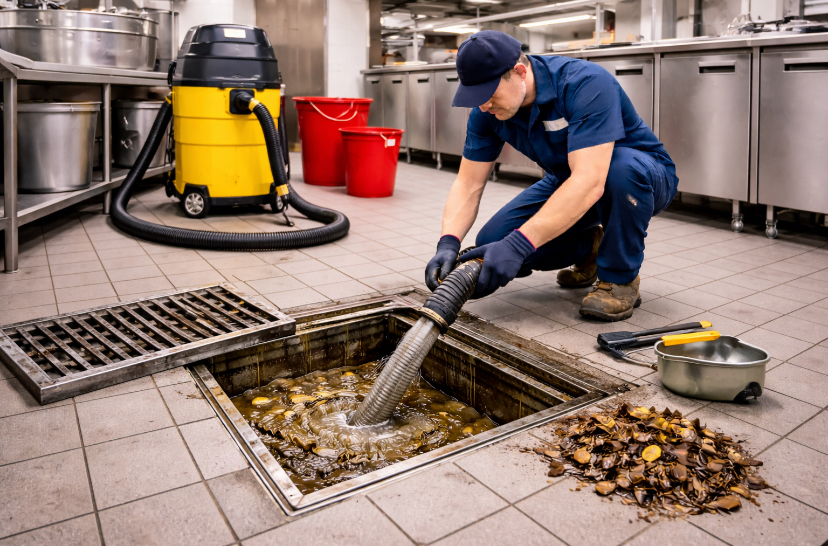
All accumulated grease, floating solids, and wastewater are pumped out of the trap using professional extraction equipment. This removes the bulk of the waste — but pumping alone does not finish the job.
The interior walls, baffles, and the inlet and outlet pipes are scraped and cleaned by hand. Hardened grease and sludge build up on these surfaces over time, and pumping does not reach them. Leaving this buildup behind reduces the trap’s effective capacity and leads to faster refilling.
The trap is flushed with water and flow is tested from the kitchen fixtures. Your plumber confirms that water moves through the trap and out the outlet at the proper rate. If flow is restricted, the issue is identified and addressed before the lid goes back on.
All waste removed from the trap is transported and disposed of according to City of Houston and TCEQ regulations. Grease trap waste cannot be dumped into the sanitary sewer, storm drains, or dumpsters. Your plumber handles the full disposal process. High-volume restaurants along Westheimer, Richmond Avenue, and the Galleria area rely on this scheduled service to stay compliant during peak operations.
The plumber inspects for damage — cracked baffles, corroded walls, deteriorating seals, or broken pipe connections are documented and reported to you. A cleaning log entry is recorded with the date, condition, and any issues found. This record supports your compliance documentation for City of Houston inspections.
How Often Houston Restaurants Should Schedule Grease Trap Cleaning
There is no single cleaning schedule that fits every Houston kitchen. The right interval depends on your trap size, the volume of food you prepare, and the type of cooking your kitchen does. Here is a practical guide.
The 25% rule. Clean your grease trap when it reaches 25% capacity of grease and solids. At that point, the trap starts losing its ability to separate grease from wastewater effectively. Waiting until the trap is completely full means grease is already passing through into the sewer line.
Small under-sink traps in low-volume kitchens — cafes, delis, small bakeries — should be cleaned every 30 to 60 days. These traps have limited capacity and fill quickly even with moderate grease output.
Medium traps in moderate-volume restaurants should be cleaned every 30 to 90 days. The exact interval depends on how much fried food, sautéed dishes, and oil-based cooking your kitchen produces daily.
Large in-ground interceptors in high-volume kitchens — full-service restaurants, catering operations, hotel kitchens — should be cleaned every 30 to 90 days depending on daily output. Restaurants in the Energy Corridor and Memorial City area with heavy lunch traffic generate peak grease volume during weekday service and often need the shorter end of that range.
Houston’s heat plays a role. During the warmer months from April through October, grease breaks down faster inside the trap. Decomposition accelerates odor and increases the chance of blockages. Many Houston restaurants shorten their cleaning interval during summer to stay ahead of the buildup.
Keep a written or digital cleaning log with dates, service provider, and trap condition after each visit. The City of Houston may request these records during routine health or plumbing inspections. Your plumber can recommend a specific schedule based on your trap size, kitchen volume, and the type of food you serve.
Grease Trap Repair and Replacement for Houston Businesses
Not every grease trap problem is solved by cleaning. When the trap itself is damaged, corroded, or undersized for your kitchen’s output, you need to decide between a repair and a full replacement. The right choice depends on what the inspection reveals.
Repair works when the damage is limited. A single cracked baffle, a failed seal, or a broken inlet or outlet pipe connection can be repaired if the trap body is still structurally sound. These are isolated issues that do not affect the trap’s overall capacity or function once they are fixed.
Replacement is the right call when the damage is widespread. Heavy corrosion across the interior walls, multiple cracked baffles, or a trap body that is deteriorating beyond effective repair all point to replacement. Continuing to clean a trap in this condition only delays the inevitable — and increases the risk of a backup or a failed inspection.
An undersized trap cannot be repaired into compliance. If your kitchen has expanded since the trap was installed — more fixtures, higher volume, a larger menu — the original trap may no longer handle the output. Older Houston restaurants in The Heights, East Downtown, and Montrose often run into this issue when the kitchen has grown but the grease trap has not. The only solution is a properly sized replacement.
Repeated backups despite regular cleaning are another strong indicator. If the trap fills to capacity well before its scheduled cleaning date, it is likely too small for your operation.
New replacement traps must meet City of Houston plumbing code for sizing, access clearance, and placement. Your plumber evaluates the existing trap during a cleaning visit, documents its condition, and recommends repair or replacement based on what the inspection shows. If replacement is needed, the plumber handles sizing calculations and coordinates with the city.
Grease Trap Installation Requirements in Houston
If you are opening a new restaurant, renovating a commercial kitchen, or adding food service to your Houston business, a grease trap is required. Understanding the City of Houston requirements before you start your buildout saves time, money, and the headache of rework after the kitchen is already built.
The City of Houston requires a grease trap for every commercial food service establishment. This includes restaurants, food trucks with commissary kitchens, catering operations, and institutional food service facilities. If your business prepares food and has kitchen fixtures that produce grease-laden wastewater, you need a trap.
Trap size is not one-size-fits-all. The City of Houston calculates the required size based on the number and type of kitchen fixtures — prep sinks, three-compartment sinks, dishwashers, and floor drains — and the expected flow rate. A small cafe with two sinks has very different sizing requirements than a full-service restaurant with a dozen fixtures. Getting this calculation wrong means failing inspection or installing a trap that fills too quickly to be practical.
Under-sink traps handle individual fixtures and are used in smaller operations. In-ground interceptors handle the full kitchen output and are required for larger restaurants with higher flow rates.
A plumbing permit is required for all new grease trap installations in Houston. The City of Houston inspects the installation before the system is approved for use. Your plumber coordinates the inspection and makes sure the trap meets code before the inspector arrives.
Many new Houston restaurants in developments along Washington Avenue, Midtown, and The Heights need grease trap installation as part of their buildout. A licensed plumber handles the sizing calculations, permit applications, installation, and final inspection coordination — from start to finish.
Plan your grease trap installation early in the buildout timeline. The trap’s location affects your plumbing layout, kitchen design, and the access clearance needed for future cleaning. Adding it as an afterthought often means tearing into finished work.
Why a Licensed Plumber Should Handle Your Houston Grease Trap
It is tempting to cut costs by cleaning the grease trap yourself or hiring the cheapest service you can find. But grease trap work in Houston involves more than scooping out grease — it carries legal, regulatory, and operational risks that a DIY approach cannot address.
A licensed plumber fully cleans the trap. Professional extraction equipment pumps out all grease, solids, and wastewater. The interior walls, baffles, and pipe connections are scraped and cleaned by hand. A shop vac or bucket removes the floating grease on top — but it leaves behind the sludge, hardened buildup, and settled solids at the bottom. The trap looks cleaner on the surface, but it is not actually clean. Capacity is reduced, and the next backup comes sooner.
Disposal is regulated. Grease trap waste cannot be dumped into the sanitary sewer, storm drains, dumpsters, or onto the ground. The City of Houston and TCEQ regulate how and where grease trap waste is disposed of. A licensed plumber transports the waste to an approved facility and handles the full disposal process. Improper disposal can result in fines, enforcement action, and potential suspension of your food service permit.
Documentation protects your business. A licensed plumber provides a dated cleaning record that includes the service performed, the trap’s condition, and any damage found. Houston health inspectors check grease trap compliance during routine restaurant inspections. Having a complete, professional cleaning log on file puts you in a strong position.
Professional service catches damage early. Cracked baffles, corroded walls, and failing seals are identified during a cleaning visit — before they cause a backup or a code violation. A shop vac in the hands of a kitchen employee does not include an inspection.
The cost of regular professional grease trap service is far less than the cost of a kitchen backup, a failed health inspection, a TCEQ fine, or a temporary shutdown. Protecting your grease trap protects your kitchen, your license, and your business.
Frequently Asked Questions
What are the signs that my grease trap needs cleaning?
Slow-draining kitchen sinks, foul odors from the drain area, grease visible in drain lines, and standing water near an in-ground trap are all signs the trap needs service. If the trap has not been cleaned in 90 days, schedule service regardless of visible symptoms.
How often should a grease trap be cleaned in Houston?
Clean when the trap reaches 25% capacity of grease and solids. Small under-sink traps need service every 30 to 60 days. Medium and large traps should be cleaned every 30 to 90 days depending on kitchen volume. Houston’s summer heat often requires shorter intervals.
Can a licensed plumber clean a grease trap in Houston?
Yes — a licensed plumber is qualified to clean, repair, install, and inspect grease traps. Plumbers use professional extraction equipment to fully pump and scrape the trap. They also handle proper waste disposal according to City of Houston and TCEQ regulations and provide cleaning documentation for your compliance records.
Does the City of Houston require a grease trap for restaurants?
Yes — the City of Houston requires a grease trap for all commercial food service establishments. This includes restaurants, commissary kitchens, catering operations, and institutional food service. Trap sizing is based on fixture count and flow rate. New installations require a plumbing permit and city inspection.
Should I clean my grease trap myself with a shop vac?
A shop vac only removes surface grease — it does not reach the sludge, hardened buildup, or solids settled at the bottom of the trap. It also does not satisfy City of Houston or TCEQ disposal requirements. A licensed plumber fully cleans the trap and disposes of all waste at an approved facility.
When should a grease trap be replaced instead of repaired?
Replace the trap when it has heavy corrosion, multiple structural failures, or is undersized for your kitchen’s current output. An undersized trap cannot be repaired into compliance — it must be replaced with a unit that meets City of Houston plumbing code for your fixture count and flow rate.
Schedule Your Grease Trap Service in Houston — Call (281) 247-5055
A neglected grease trap puts your kitchen, your compliance record, and your business at risk. The Houston Plumbing Company is ready to clean, repair, or install a grease trap that keeps your Houston restaurant running without interruption. Restaurants pair trap service with scheduled commercial drain cleaning on kitchen lines.
- Licensed and insured Houston plumbers — grease trap cleaning, repair, and installation
- Same-day and emergency grease trap service available
- Free estimates with transparent pricing before work begins
- Cleaning documentation provided for City of Houston compliance records
- 4.9-star Google rating — trusted by Houston restaurants and commercial kitchens
Call (281) 247-5055 now to schedule grease trap service for your Houston business.
Visit us online: www.thehoustonplumbingcompany.com